
EMDR trauma treatment
What is EMDR?
Eye Movement Desensitization and Reprocessing (EMDR) is one developed by Dr. Francine Shapiro developed an established trauma-processing psychotherapy method that significantly improves the treatment of traumatized people. The effectiveness of EMDR in trauma therapy has been scientifically confirmed. EMDR was originally used to deal with traumatic experiences. The method is now used for trauma management as well as for phobias, anxiety and self-esteem disorders, panic attacks, depression, burnout, personality disorders, attachment disorders, chronic pain and to support grieving processes as well as performance blocks.
How does EMDR treatment work?
In the therapeutic conversation, the specific problem is identified, the needs are clarified and an individual treatment plan is drawn up. EMDR treatment includes a clearly structured process. Before the actual process, methods are used to stabilize and strengthen the clients and a sign is agreed upon with which the clients can stop the processing at any time if the stress becomes too great. The main active principle of EMDR treatment is bilateral hemisphere stimulation, which means that the right and left hemispheres of the brain are alternately stimulated. This is done either through tactile stimuli, such as brief touches; acoustic signals or visually achieved through rapid eye movements. Bilateral stimulation causes both hemispheres of the brain to work together synchronously. In this way, better processing and integration of traumatic experiences can be achieved. This makes it possible to approach the triggering event without being overwhelmed by the stressful feelings.
Effect of EMDR therapy
We store normal experiences in our memory by sorting them and linking them to previous content. A trauma, on the other hand, is probably not sorted normally, but is stored separately along with all the associated sensory impressions and thoughts. Later, anything that reminds of the trauma - a loud bang, a smell, a touch - can make the person affected feel like they are reliving the situation. Fear, helplessness and physical reactions such as shortness of breath and racing heart are the result. Treatments that focus on the psychological conversation help to understand what happened, but the event remains stored in the brain in such a way that it continues to trigger the unpleasant feelings and physical symptoms. The aim of EMDR therapy is therefore to sort the memory of the trauma into your memory like a normal memory. Those affected should no longer feel defenseless back in the situation, but should be able to perceive and endure the memories normally following trauma treatment - without unpleasant feelings and physical symptoms being triggered.
Is EMDR actually effective?
The effectiveness of EMDR has already been proven in numerous studies. Research results show that 80 percent of patients with simple post-traumatic stress disorder feel significantly relieved after just a few EMDR sessions. According to research, the use of EMDR is said to achieve the same treatment effects as other treatment methods in less than half the treatment hours.
Self-experience EMDR (Eye Movement Desensitization and Reprocessing)
As part of my psychology internship, I was given the opportunity to take part in EMDR treatment. Since I only knew EMDR from stories before, I was very happy to be able to have my own experience with it. The EMDR method attributes physical symptoms to stressful and insufficiently processed memories. Alternating bilateral stimulation using eye movements is intended to activate the brain's information processing system and reprocess the stressful memory.
The treatment began with an anamnesis interview in which I described my problem. The subject of my treatment was a very painful visit to the dentist because the very thought of ever getting an injection or going to a dentist again caused fear in me and my heart began to race. We began the treatment, whereby I was first asked to put myself back in the situation that was stressful for me. I initially rated my stress at 8 out of a total of 10 points, which is quite high because 10 is the highest stress level. During the first back and forth movement of my eyes, the situation seemed very present to me and I also noticed a faster heartbeat. But after just a short time I was able to notice how I was able to (inwardly) distance myself from the situation at the dentist's chair and instead, other, positive memories came to mind. I was amazed at the images and memories that came to mind and how quickly they changed in my mind's eye. When asked how high I estimated the stress, I noticed after each stimulation how the event faded into the background for me and lost its painful value. Finally we reached a stress level of 1.
Admittedly, I was very surprised at what could be achieved in such a short time using this seemingly very simple method. I will also come back to EMDR for future problems of various kinds. If you are open to new things and are looking for an effective treatment that brings immediate results, you should definitely try the EMDR method yourself!

Certificates - emdria EMDR International Association


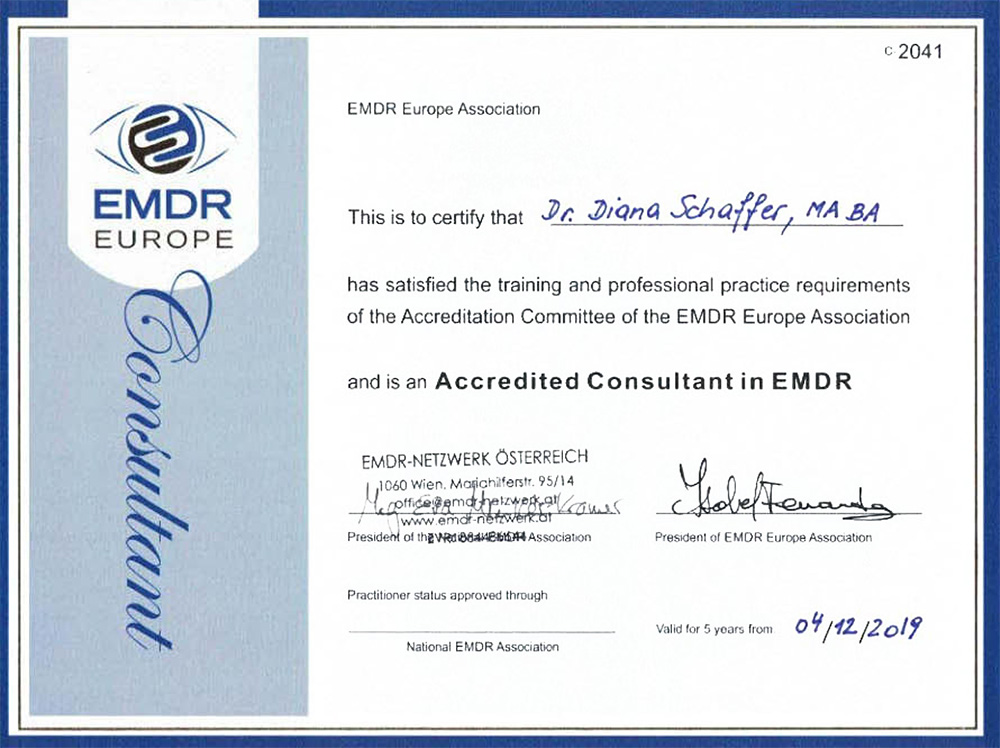
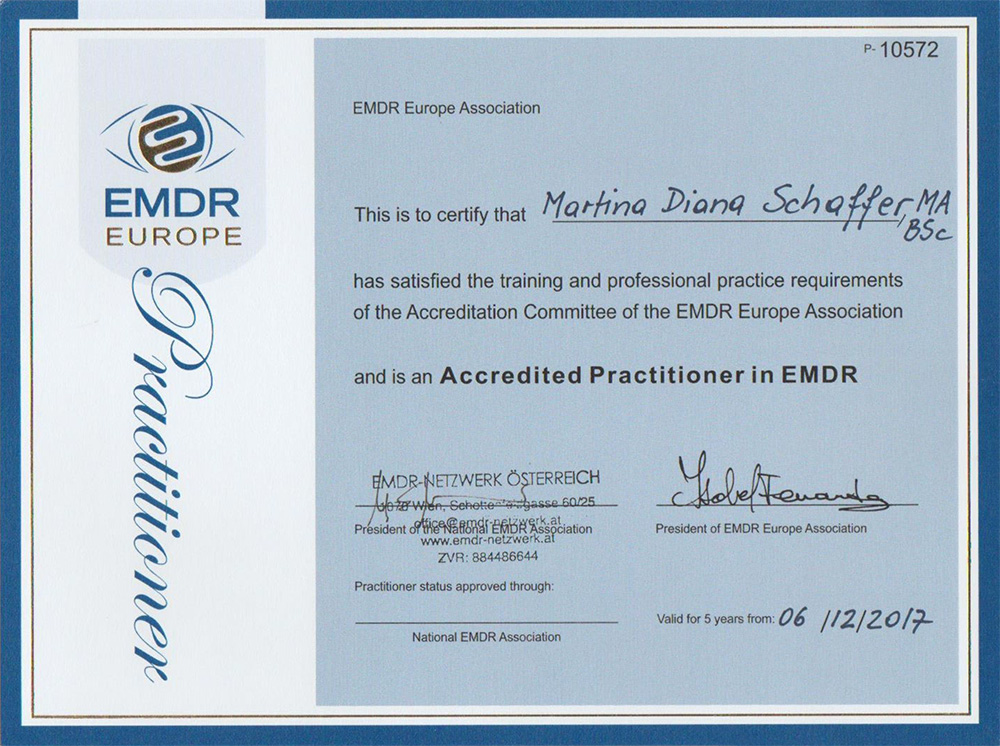
Certificates - EMDR Europe Association
Online therapy
You don't want to come to my practice in person (COVID-19), or do you live too far away?
Die Behandlung ist auch via Skype & Co. möglich!